Capture the useful context
Broad availability, time away, and quiet hours should take less effort than maintaining another personal calendar.
03 / WGTakt
Household chores, availability, and scheduling, connected so that the next task reflects what has actually happened.
The project
A recurring reminder cannot tell the whole story of a shared home. People leave, come back, complete a chore early, or do the first step of a task that someone else needs to finish. WGTakt connects those events to the schedule.
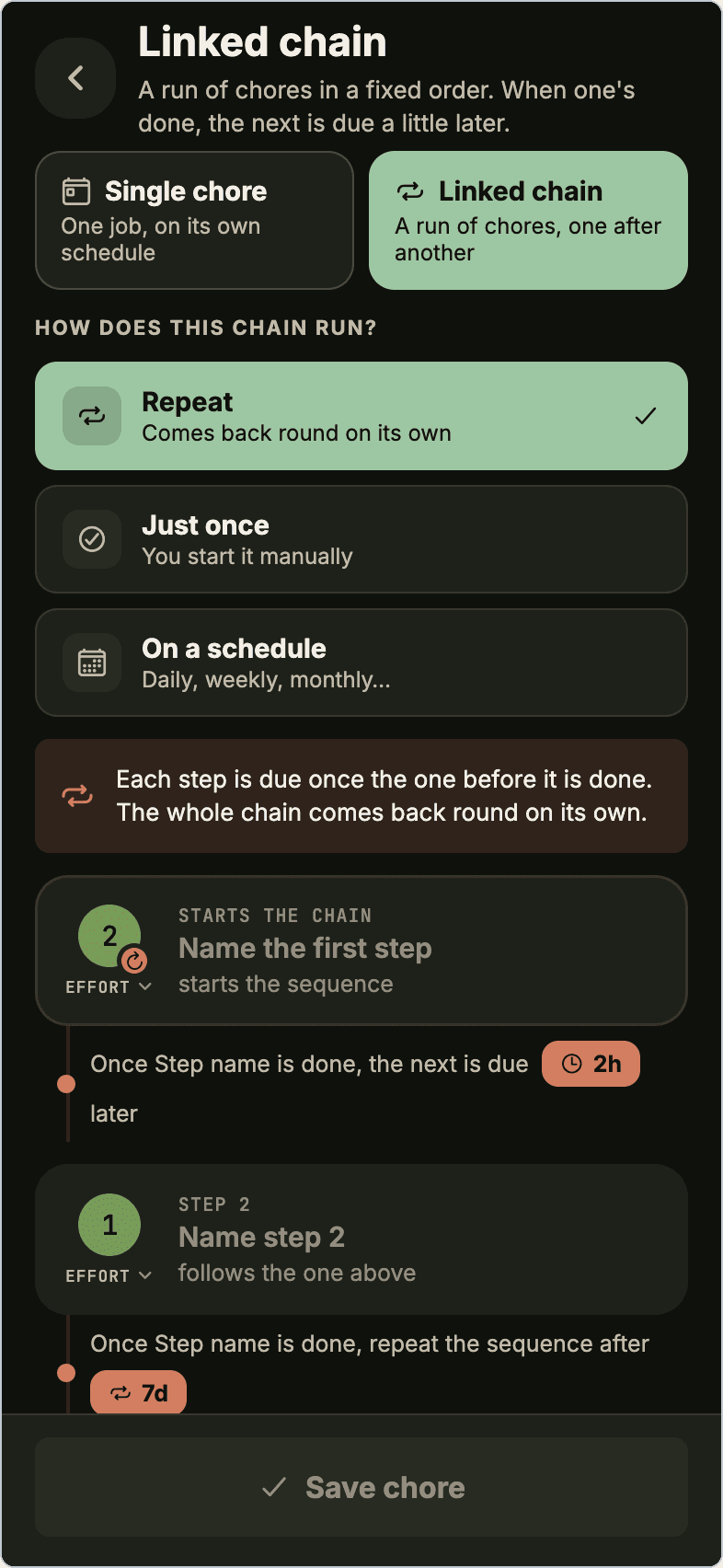
This project spans mobile interactions and backend rules. Painting availability should feel immediate. A monthly task should use a calendar month. A linked task needs an event and a delay, not just another item in a list.
The journal shows how I use detailed development conversations, prototypes, implementation checks, and real use to work through those decisions. Household identities and private activity are left out of the public account.
Broad availability, time away, and quiet hours should take less effort than maintaining another personal calendar.
Completion, rescue, and linked tasks change what should happen next. Fixed and completion based schedules need different rules.
Joining a household, sharing future turns, and seeing the consequences of an edit all need to work beyond the single user happy path.
7 chapters / 21 May 2026 onwards
The app had already filled in my schedule. Editing it was the hard part.
Running it and emptying it are different jobs. The product needed to connect them.
The chat composer and the tab bar were competing for the same space.
Changing a chore’s schedule exposed an old assignment that should no longer have existed.
Adapting a chore’s rhythm needed a limit that people could understand.
A vacation range did not need separate From and Until interactions before the calendar could do its job.
I asked for a household of four, then three separate people joining it.
The working record
Original captures, visible details,
and room to look closer.