Start with their words
Freeform service descriptions preserve the person’s own label. Follow up questions should reveal specialisms, constraints, and evidence of their work.
02 / Neeed
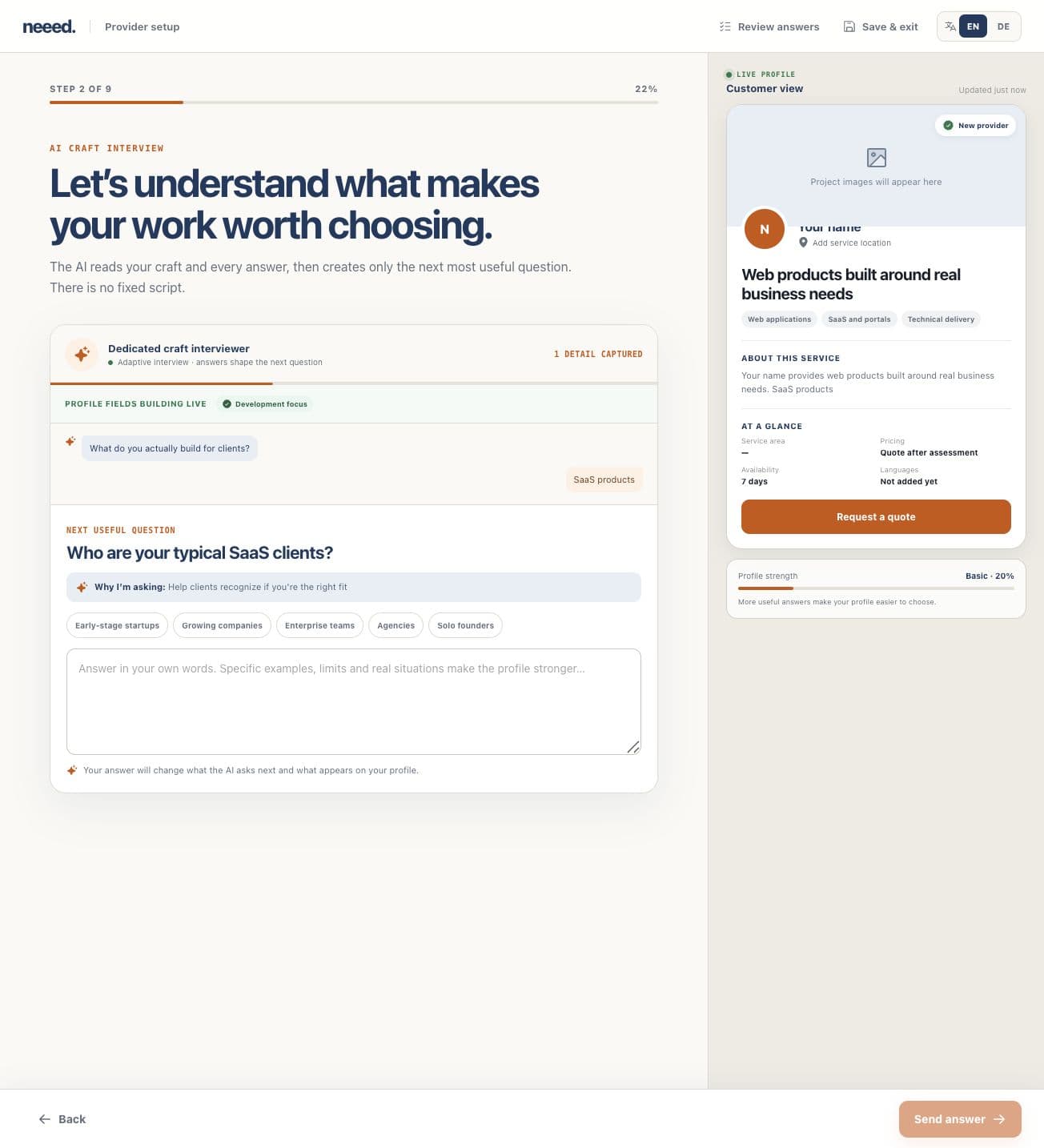
AI interviews service providers and turns their responses into structured profiles. The next question has to fit the person answering it.
The project
A photographer, a cake maker, and a software engineer should not have to squeeze their work into the same form. Neeed is a service platform built around understanding what someone offers and what another person needs.
The AI interview is one part of a larger system. Answers need to become useful, editable profile information. A model response needs to survive validation and reach the interface. Service matching needs distinctions that a broad category cannot express.
I work across those boundaries: the question people see, the schema that carries the answer, the profile it becomes, and the cases that break the happy path. The September work on adaptive customer forms is still a local iteration in the source record.
Freeform service descriptions preserve the person’s own label. Follow up questions should reveal specialisms, constraints, and evidence of their work.
Normalize responses, validate control shapes, keep understood details editable, and show a retry when the interview cannot continue.
An attractive profile must not invent a price, a review, or an availability claim. Structure should help people compare real information.
6 chapters / 9 Apr 2026 onwards
Different services need different ways to show what makes them worth choosing.
A response shape mismatch quietly turned a live AI interview into hardcoded questions.
A long software development description exposed both an input limit and a cross language false match.
A polished generated profile must not turn missing information into a confident claim.
An adaptive form still needs a stable place to read, answer, and understand progress.
The next iteration gives the AI a richer interface vocabulary while keeping the person in control of what it understood.
The working record
Original captures, visible details,
and room to look closer.