A portfolio is part of the answer.
Different services need different ways to show what makes them worth choosing.
A service profile has to do more than name a category. For creative work, examples can carry information that a generic description never will. I asked for portfolio and social work references to fit naturally into provider onboarding and settings.
The larger question was how that information would survive the whole path from editing a profile to viewing it publicly.
See the original requestInside the screen
The portfolio starts with a choice.
I want the work to help someone decide whether this is the right person for the job. The collection screen is only the beginning of that responsibility.
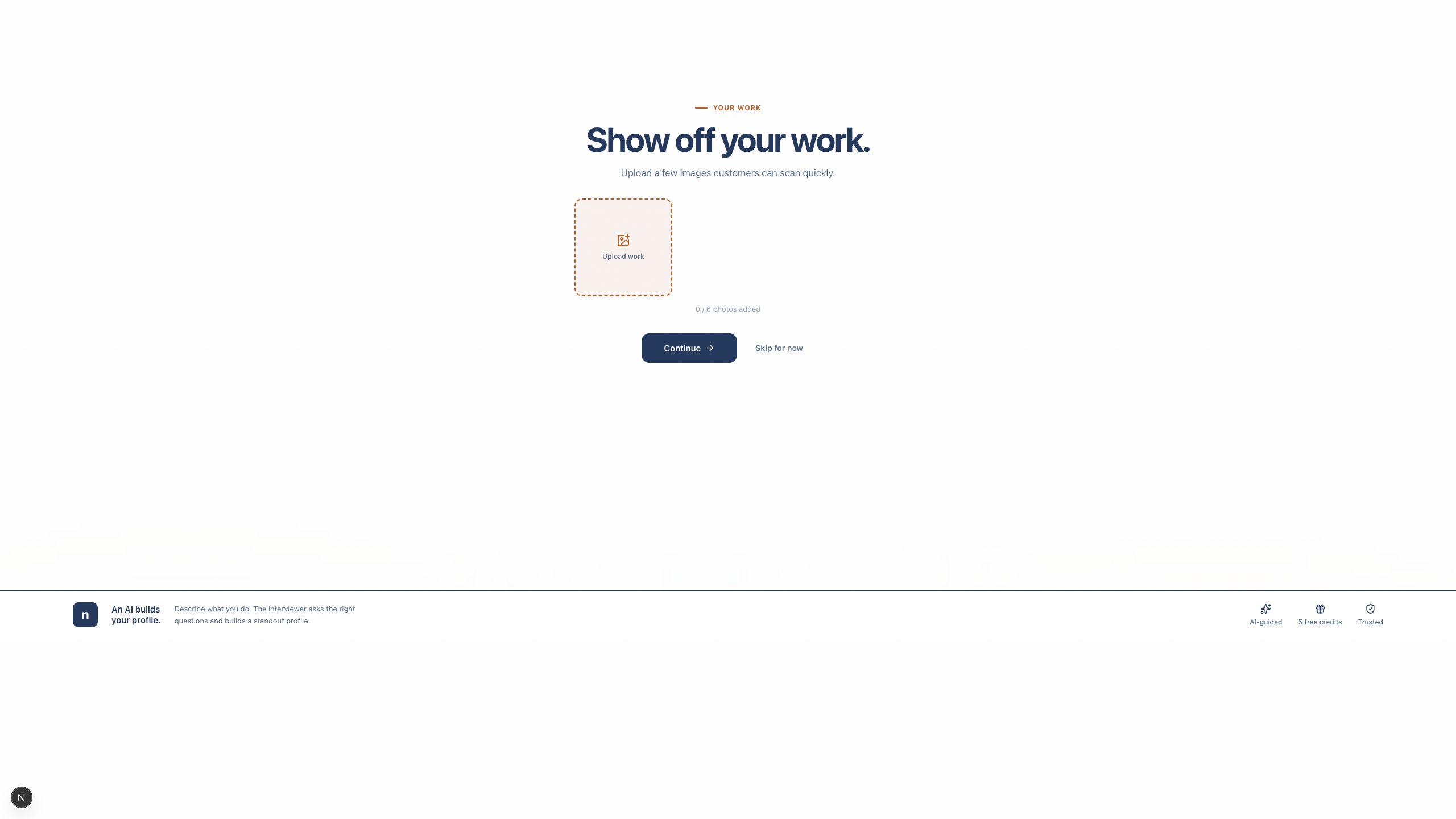
Select a detail
The upload tile makes examples of work part of the provider journey. I would inspect what happens after selecting a file, including failure and recovery, before treating the tile as a finished portfolio.
The 0/6 counter communicates a bounded gallery. Six relevant examples can tell a clearer story than a pile of unrelated images, but the interface still needs to help people choose what to show.
Skip for now gives someone without images a way forward. I want an optional portfolio to support the profile, rather than quietly become a requirement to join.
This July capture shows collection controls. It does not prove that uploaded work appears on a public profile.
The original request9 Apr 2026 · excerpt
for all service providers which deal in creative stuff, make sure to feature instagram/portfolio
Excerpted from the development conversation. Punctuation is lightly edited; the surrounding story is an edited retrospective.
01
The missing piece was on the other side of Save.
It is easy to ask an AI coding tool to add a portfolio field and then judge the result in settings. The input appears, the value saves, and the task looks finished. But that is only the provider half of the experience. The person hiring them may be reading a different data shape, a cached summary, or a claimed profile with its own defaults. I had to follow the information to that reader before the original request could be considered useful.
The April follow up mattered because the details were specific. A photographer’s editing style is different from a DJ’s setup time. A salon’s booking mode answers another kind of question again. Passing those values into the public profile protects distinctions that a shared template can otherwise flatten. The visual design can stay consistent while the content changes to fit the work.
02
Saved is only half the journey
Follow up implementation notes on April 12 recorded a bridge between saved settings and claimed public profiles. Photography details, DJ setup information, and salon settings were no longer lost behind generic fallback summaries.
That is a quiet but important data flow problem. The settings screen can show the correct value while a public profile still renders a stock version. Testing only the editor would miss the failure.
03
Uploading evidence is a separate moment from explaining it.
The actual July onboarding capture asks providers to show their work and offers space for six images. That is a later view of collection, not a screenshot of the April public profile bridge. What catches my eye is the optional route beside Continue. Someone should be able to keep describing their service without inventing a portfolio just to satisfy the form.
I would review the resulting profile by asking what each image helps a customer decide. Does it show the style of a finished piece, the scale of a job, or the kind of setting the provider can handle? The gallery does not need a large marketing paragraph to do useful work. It needs the right context, truthful ownership, and a clear connection to the service. The next useful check is the complete edit, save, reopen, and public view loop.
04
June 19: the evidence also mattered to matching.
“there could be a lot of photographers but the one that customer is really looking for should be specific to that particular expertise”
The portfolio question returned in a later matching proposal. Calling someone a photographer does not say whether they make catalogue images or document weddings. Examples, capabilities, and practical constraints provide different kinds of information, and a broad label cannot stand in for all of them.
The proposed architecture applied required constraints before semantic ranking and limited model comparison. That was a design direction, not a verified matching system. It gave the earlier portfolio work a larger purpose: collect useful evidence without claiming that uploading images alone establishes suitability.
A convincing profile needs both useful evidence and honest claims. I return to that question in A price needs a unit. A profile needs evidence.
Where this chapter landed
What changed.
Subsequent April 12 work connected category specific saved settings to claimed public profiles. This entry’s April 9 date marks the originating request, not an assertion that the entire bridge shipped that day.
Added while revisiting this story · September 2026
The thinking behind the detail.
Research notes to take these decisions further. These sources were reviewed for this retrospective.
Saving should have a perceivable result
W3C’s status message guidance is relevant to uploads and saved profile changes. A visible update alone may not communicate completion to someone using assistive technology. That is an additional check beyond the saved value reaching the public profile.