PROJECT / SEO DASHBOARD
SEO Dashboard
The SEO Dashboard thread is really about one question: can search work become visible enough to act on?
A reporting and validation lane for making SEO decisions inspectable instead of hidden in spreadsheets or plugins.
ACTUAL PROMPT / THREAD TRACE
Dashboard implementation, QA, accessibility checks, and reporting interface work.
WHY IT MATTERS
It connects cost articles, Pressroom, and this blog's own hardcore SEO layer into one pattern of source-backed visibility.
HOW TO READ THIS
Each entry is a dated design decision: the pain point, the response, the proof source, and the visual artifact when the archive had one.
DATED JOURNEY
DATE INDEXRaw search numbers needed safer meaning
SEO data is easy to collect and easy to misread.
The seo-dashboard project includes normalization work around clicks, impressions, and CTR.
That is the same discipline as the cost-article source_id clarification: make the metric mean one thing.
seo-dashboard scripts and related project scan.
SEO moved into article review
The best dashboard is sometimes a drawer inside the work.
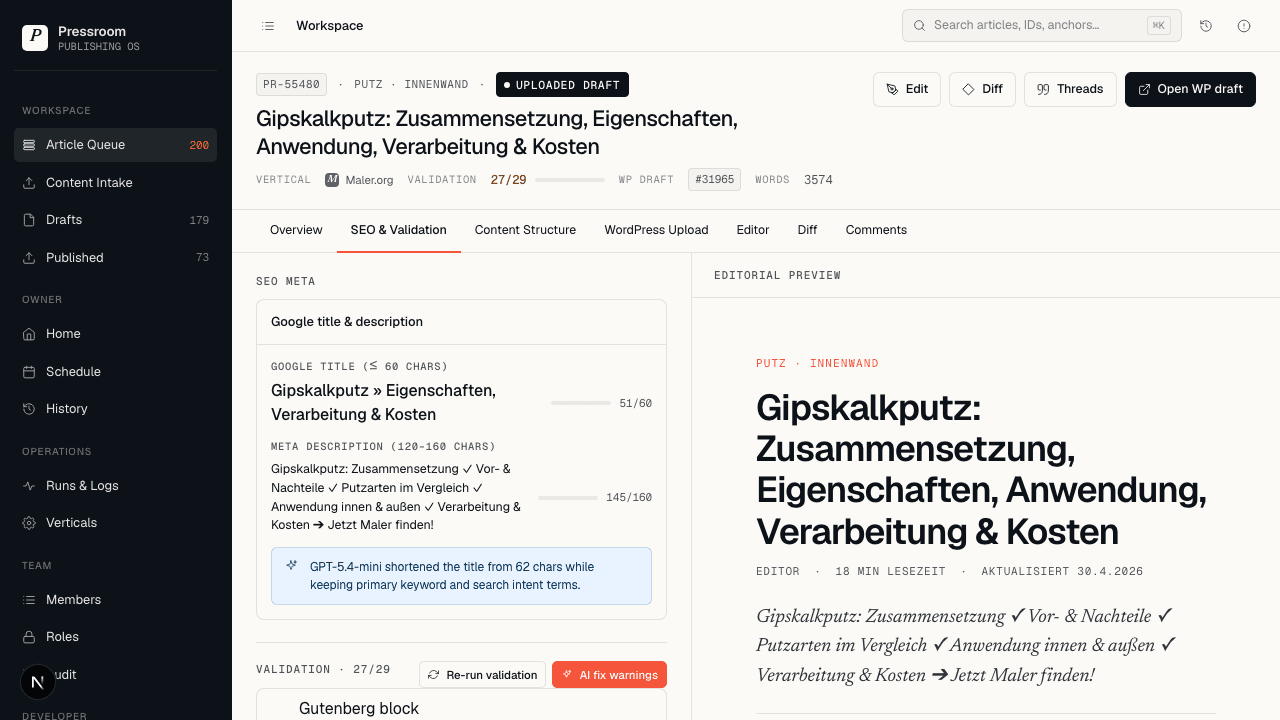
Pressroom's SEO validation panel made metadata, anchors, and affected blocks visible during review.
That makes the SEO layer action-oriented instead of passive reporting.
Pressroom manager SEO screenshot and SEO_PANEL_RULES.
Cost article SEO needed structure, not polish
A cost guide ranks better when the structure is true.
Scripts repaired cost article headings, source usage, Kurzantwort patterns, and lexicon structures.
The point is not stuffing keywords. The point is making the content machine consistent enough to trust.
CMSContent and costarticles repair scripts.
The blog got its own crawl layer
A build log should be crawlable the moment it becomes useful.
The emsqre site gained sitemap, robots, RSS, canonical metadata, JSON-LD, and cache headers.
This turns the blog into part of the SEO practice, not just a place to talk about it.
Current daily-build-log SEO files.
SEO became a public workflow story
The strongest SEO work is legible to humans first.
The project page now connects dashboards, article validation, cost-guide generation, and the blog's own search infrastructure.
That is the resource angle: show readers the system behind the result.
Current project journey restructuring.